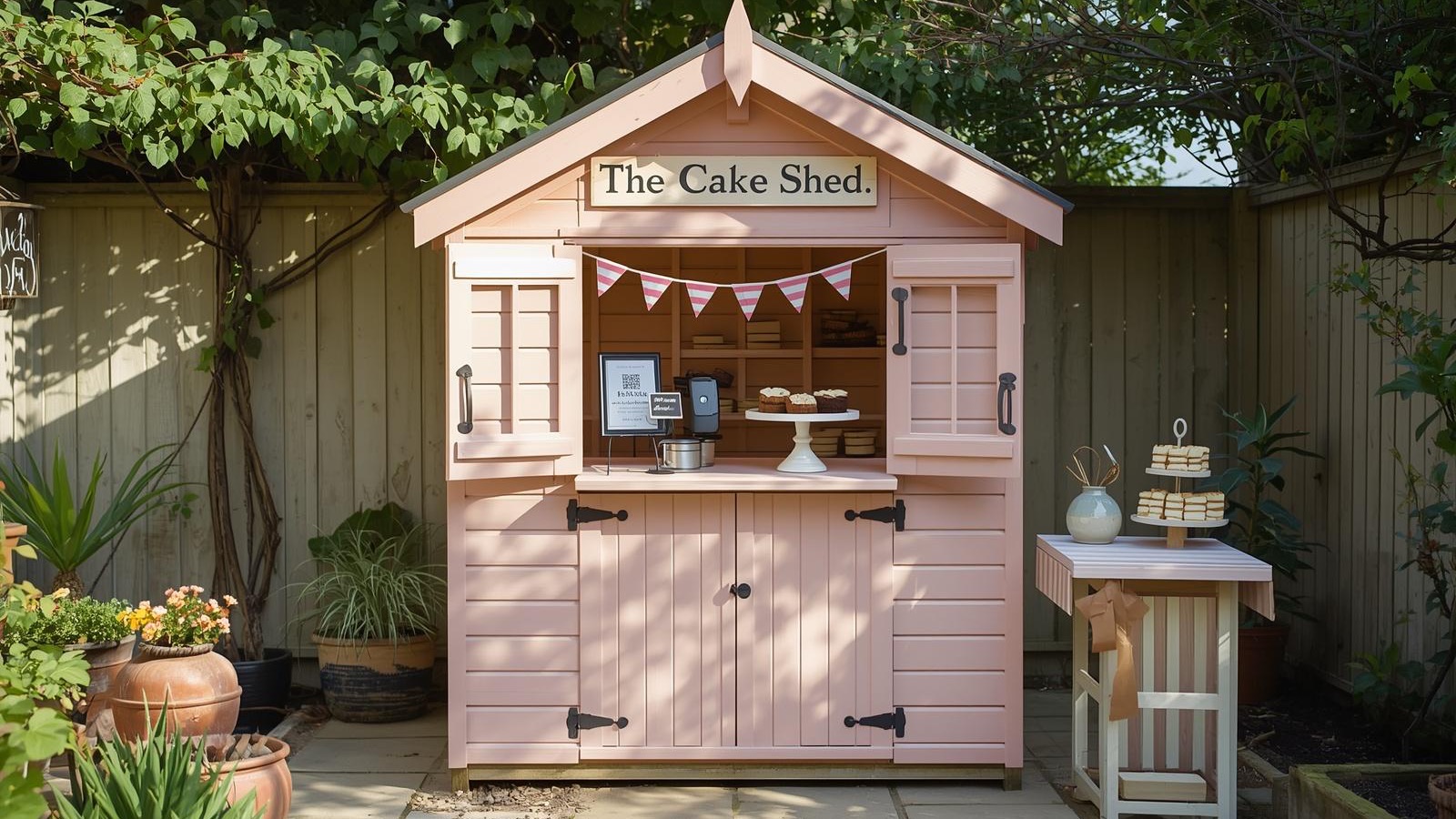
You set up the shed because you love baking. The first weekend, somebody stops, looks at the brownies and traybakes on the shelf, looks at the honesty box, and says “I’d love one but I haven’t got any cash.”
That sale just walked away — and so did the next four, all because the shed only took cash. This guide shows you how to set up your cake shed to take card payments properly. Which setup actually works in a garden shed (signal, power, weatherproofing, signage), how to handle people who take without paying, and how to make sure the transaction fees do not quietly eat the margin you worked so hard to build.
- Around a third of UK adults rarely carry cash — cash-only is costing you real sales
- SumUp Solo Lite is the best fit for most cake sheds: £25 reader, 1.69% per transaction, no monthly fee
- QR code payment is a free backup — same fees, no hardware needed, ideal for unattended sheds
- Add roughly 2% to your prices to absorb card fees without losing margin
- Shrinkage (non-paying customers) is real — build a 2-5% allowance into your prices
- You do not need a business bank account or VAT registration to start taking card
Why cash-only is costing you sales
The cash-only shed is the cake shed nostalgia version. The honesty box, the jam jar, the trust-the-village vibe. It is lovely. It is also, increasingly, leaving money on the table.
UK Finance’s 2024 Payments Markets Report shows that cash now accounts for just 12% of UK payments, down from 51% a decade ago. About a third of UK adults say they “rarely or never carry cash”. Among under-35s, that figure is closer to half.
What that means for your shed: if a passer-by stops, looks, decides they want a brownie or a slice of traybake, then realises they have no cash — most of them will not walk back home and come back. They will say “next time” and move on. You lose the sale, the customer, and the future repeat.
Adding card payment is the single highest-leverage change a cake shed can make. The hardware pays itself back in a single busy weekend for most sheds. Then it just keeps converting walk-bys into sales for as long as it is sitting there.
Cash, card, or QR code?
You have three real options. Most shed owners end up using all three.
Cash — still useful for the older village regulars, kids buying with pocket money, and the occasional change-only sale. Keep the jam jar or honesty box. Just do not rely on it as your only option.
Card reader — a small physical device that takes contactless cards, chip-and-pin, Apple Pay and Google Pay. Costs £19-£69 one-off plus a per-transaction fee. Best for sheds you attend during selling hours and for customers who expect tap-to-pay everywhere now.
QR code payment — a printed code customers scan with their phone, which opens a payment page (powered by the same providers as the card readers). No hardware at your end, no battery, no Wi-Fi at the shed itself. Free to set up. The ideal fit for a fully unattended shed — and the natural backup for when your card reader battery dies mid-weekend.
Most sheds end up with: cash jar or honesty box + QR code laminated on the wall + a card reader on the counter when the shed is attended. Belt and braces. The cost of being wrong is one missed sale.
SumUp Solo Lite is the right card reader for most cake sheds — £25 hardware, 1.69% per transaction, no monthly fee. For the full comparison of SumUp, Square, and PayPal Reader (formerly Zettle), plus why Tap to Pay on your phone might be all you need below a certain volume, see How to take card payments as a home baker (UK).
Setting up the reader in a shed
Once the reader arrives, here is how to actually make it work in a garden shed environment — which has its own quirks.
A note before we start: card readers work best when the shed is attended. The reader needs to be paired with your phone and reachable by customers, and leaving it alone all day invites both battery death and theft. If your shed is fully unattended most of the time, the QR code option in the next section is probably a better fit as your primary card method, with the reader brought out only when you are there.
Power. Card readers are battery-powered and need charging every few days. Most sheds have no electricity, so charge the reader in the house overnight. The battery holds 8-12 hours of active use — easily a full weekend of attended selling.
Signal. The reader pairs with your phone over Bluetooth, then uses your phone’s mobile data to authorise the payment. If your phone gets signal at the shed, the reader works. If your shed is in a signal black spot, run a Wi-Fi extender from the house — a £20 unit covers most domestic gardens.
Weatherproofing. UK weather is the enemy. Keep the reader inside a small lidded tin or a plastic Tupperware when not in use. If your shed has a roof leak, fix it before the reader arrives — water damage voids the warranty.
Theft-proofing. A card reader on a counter is more attractive to thieves than a jar of coins. At night, take the reader inside the house. During unattended hours, either bring the reader in with you or tether it with a cable lock to the counter. Most shed owners simply bring it in when they are not actively selling and rely on the QR code the rest of the time.
Signage. Print a small sign — “Card, contactless, Apple Pay and QR code payments welcome” — and tape it to the front of the shed. Conversion lift is real. People decide whether to stop based on what they can see from three steps away.
The free QR code option
If your shed is unattended for most of the day — or you just want to take card payments without buying any hardware — every provider above also gives you a free QR code (or “Tap to Pay link”) option. This is the most important single upgrade for the classic UK unattended honesty-box cake shed.
You generate a static QR code in the SumUp or Square app. You print it (or laminate it for outdoor durability). You stick it on the shed wall next to the products and a clear price list. Customers scan it with their phone camera, the payment page opens, they enter the amount or pick the item from a list, they pay. Same per-transaction fee as the card reader. Zero hardware cost.
This is brilliant as:
- Your primary payment method for fully unattended sheds where a card reader cannot live outside
- Your only payment method if you want to spend £0 on setup
- A backup for when the card reader battery dies mid-weekend
- A second payment point if you have separate display areas (one QR by the brownies, one by the traybakes, no need to hand a reader around)
The downsides: it is one extra step for the customer (open camera, scan, wait for page, type amount). For older customers, the physical card reader is faster and feels more familiar. For under-40s, the QR is fine and often preferred. A laminated “How to pay” card next to the QR with three simple steps solves most of the friction.
Managing cash safely
Even with card and QR available, you will still take some cash. Here is how to handle it without it becoming a security or accounting headache.
The honesty box itself. Lockable, heavy enough that it cannot be walked off with, bolted to the shelf if possible. A small slot at the top that only fits coins and folded notes going in, not fingers coming out. Empty it daily during high season.
Float. If your shed is attended and you are giving change, keep £20 in mixed coins and £5 notes in a small lockable tin. Most honesty-box sheds skip the float entirely — customers figure out how to make exact change, or round up.
Banking. Cash adds up faster than you think. Walk it to the bank (or use a Post Office paying-in service) at least monthly. Beyond £200 sitting in your house, you are unnecessarily insurance-exposed.
Records. Either count the float at the start and end of each day and record the difference, or — much easier — push customers toward card/QR and let the payment app do your bookkeeping for you. The card reader app will give you a clean monthly report you can hand straight to an accountant.
Theft. Honesty boxes get raided. If the shed is unattended overnight and you have cash sitting there, you are the village’s most predictable target. Bring all cash inside every night. Make a habit of it. The card reader and phone come in too.
How to factor transaction fees into your prices
Card fees are small per transaction but compound fast at shed volume. Here is the shape of it for a typical shed turning over £700 a month.
The fix: add 2% to your card-paid prices — a 10p bump on a £3.50 brownie, rounded to a tidy £3.60. Customers do not notice. You absorb the fee and keep a small buffer on top. For the full methodology — why 2% covers it, and how to apply it across different channels — see How to take card payments as a home baker (UK).
Before you add 2% to your prices, you need to know what your real per-item cost actually is. The free recipe costing calculator works out ingredients and labour for any recipe in under two minutes.
When people don’t pay
Nobody enjoys talking about this part, but every cake shed owner on social media eventually posts the same thing. “Someone took three brownies and didn’t leave a penny.” It happens. It happens in villages where you thought everyone knew everyone. It happens to the nicest sheds with the kindest owners. Sadly, it is now a cost of doing business.
The honest breakdown:
- Most of your customers are honest. That is why the unattended honesty-box model works at all. The overwhelming majority will pay the right amount. A small minority will not.
- Some non-payment is not malicious. Kids buying with pocket money that does not quite cover it. A visitor who genuinely has no cash and sees no card option. A distracted customer who meant to come back.
- A small amount is genuinely bad behaviour. People who take without looking at the price. People who deliberately underpay. People who refill a pocket rather than a payment box. You cannot prevent this entirely without staffing the shed full-time, which costs more than the loss.
What to actually do about it:
Build shrinkage into your prices. A realistic loss rate for an unattended cake shed is 2-5% of revenue. At £700 monthly, that is £14-£35 gone before you start. Add another 2-3% to your prices on top of the fee-absorption bump to cover it — a £3.50 brownie becomes £3.60 or £3.65. You are not overcharging the honest majority; you are making the maths of the shed actually work.
Make paying easy. The single biggest cause of unintentional non-payment is “I don’t have cash and the shed doesn’t take card.” The card reader and QR code from this guide solve most of that. Add them, and your “didn’t pay” rate drops before you do anything else.
Signage that lightly signals attention. A simple “All sales recorded” sign at the honesty box is enough to nudge casual behaviour. A small “Notice camera in operation” sticker — only if you actually have one (a cheap £30 battery-powered motion camera counts) — signals attention without being hostile. Do not bluff on the camera; if a genuine thief realises there is no camera, word spreads and the problem gets worse.
Positioning matters. A shed visible from your window is a shed that gets less trouble. Being able to look out and see the traffic is free security. Planting the shed at the end of a long drive behind a hedge is an open invitation to casual loss.
Price list as boundary. A clear visible price list removes ambiguity. “One Biscoff Brownie, £3.50. Two for £6.50” is harder to accidentally underpay than “Brownies available, please pay what’s fair”. Even the most honest customer guesses low if they do not know the price.
Accept the residual loss. Beyond basic measures, chasing the last 1-2% of shrinkage costs more in stress and setup time than the loss itself. A cake shed that generates £8,400 a year and loses £168 to non-payment is still generating £8,232 it otherwise would not — and for most shed owners, that loss is a lower annual cost than one day’s worth of staffing a full-time bakery would be.
Price for reality, not for how you wish the world behaved.
Signage, display, and trust
The last 5% of conversion comes from how the shed looks before a customer commits to buying.
A clear “Card welcome” sign at the gate or visible from three steps away. Even better: include the contactless symbol, Apple Pay logo, and the QR code itself. All are free to download and signal “modern shed, will not be a faff to pay at.”
Visible pricing on every product. Either a small chalkboard or printed cards next to each tray. Customers do not commit if they have to guess. They see, decide, and pay.
A laminated “How to pay” card next to the honesty box and QR code. Three steps, numbered, with a contactless icon and a QR scan icon. Removes every excuse.
A receipt option. SumUp and Square both let you email or text receipts to customers. Most will not want one, but the offer signals professionalism. Tick the box in the app.
If you are there when the customer is: a nod, a smile, a brief chat about the weather. You are not chasing a transaction — you are building the relationship that makes them come back. The reader is functional; your warmth is what turns a one-off into a weekly visit.
If you are not there: a small chalkboard with your first name and “Baked fresh today by [Name]” does the same warmth in absentia. A handwritten Thank-you sign on the wall is two minutes of work that pays back for months.
Wondering whether the shed will actually pay for itself? Plug your real numbers into the free Cake Shed Break-Even Calculator — it tells you how many weeks it’ll take to recoup your setup, and what your first-year profit looks like at your trading level.
The cake shed that takes card, takes QR, prices clearly, and accepts a realistic amount of shrinkage converts roughly twice as well as the cash-only equivalent in the same village. Not because the card reader is magic — but because every barrier to “yes, I’ll have one” has been removed, and every unavoidable leak has been priced for.
You bake because you love it. The shed exists because you wanted to share that. The card reader, the QR code, the small fee absorption tweak, the honest acceptance that a few items will walk — they exist so the people who stop at your gate actually become customers, and so you are still smiling about the shed a year from now.
Set it up once. Reap the difference for every weekend after.
Common questions
Which card reader is best for a cake shed?
How much should I charge for items at my cake shed?
Will customers think it is odd that a cake shed takes card?
What if my shed has no Wi-Fi or mobile signal?
How much of my cake shed takings should I actually keep after costs?
What do I do about people who take bakes without paying?
Do I need to register for VAT if I take card payments?
Price every product properly.
Stop guessing what to charge. The Food Costing Toolkit works out every cost that goes into your products — ingredients, labour, overheads, margin, and platform fees — across six connected spreadsheets. Update one ingredient price and every recipe that uses it recalculates automatically.
Get Price It Right — £79One-time purchase · no subscription · PDF guide included