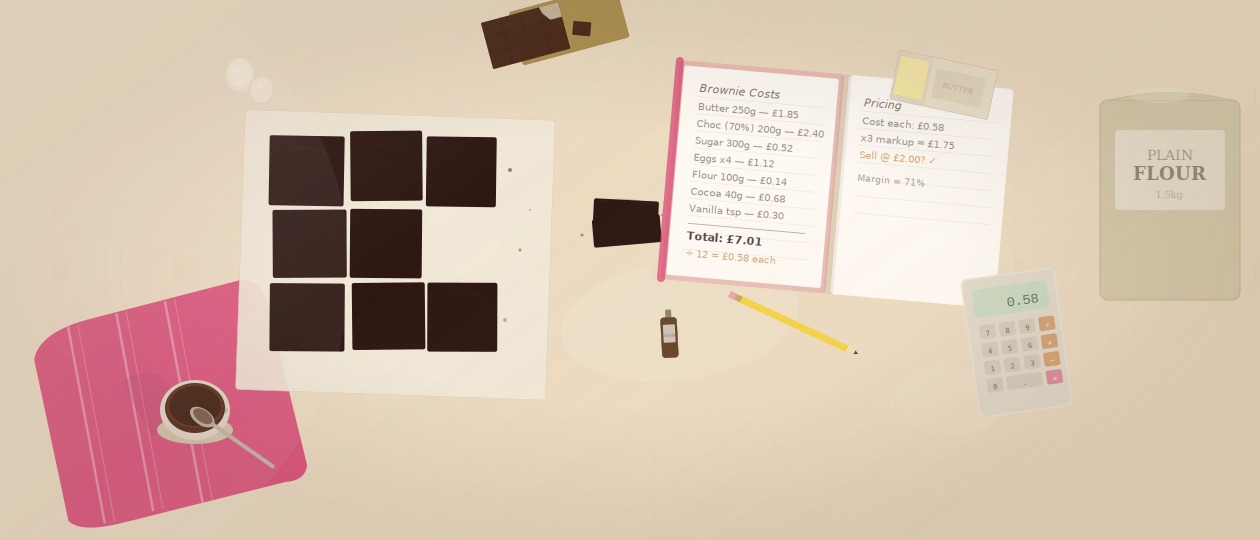
You know what your ingredients cost. Roughly. You know how long it takes to bake a batch. Approximately. And when someone asks what you charge, you say a number that feels about right.
That is how most small food businesses price their products. Not because they are careless, but because nobody ever showed them a better way. Recipe costing replaces the guesswork with actual numbers — so you can see exactly what each product costs to make, and set a price that actually covers it.
This guide walks you through the process step by step, using a real example: a batch of 16 Triple Chocolate Brownies.
- Your ingredient cost per brownie is £0.53 — but that is not your real cost
- Add labour (£0.79) and overheads (£0.48) and the true cost is £1.80 per unit
- At a 40% margin, your minimum selling price is £3.00
- Most home bakers only count ingredients — and underprice by 70% or more
What is recipe costing?
Recipe costing means adding up every cost that goes into making a product — ingredients, your time, and the overhead costs you might not think about — then dividing by the number of units you produce.
The number you get is your cost per unit. It is the minimum amount each item costs you to make before any profit. It is not your selling price. It is the floor beneath it.
Without this number, you are guessing. And most food business owners who guess are undercharging — not by a little, but by enough to wipe out their margin entirely.
Step 1: List your ingredients and work out the cost per gram
Start with your recipe. Write down every ingredient, how much you use, and how much you paid for the pack you bought it from.
The key number is cost per gram (or per ml for liquids). You get this by dividing the pack price by the pack size. This tells you exactly what each gram of each ingredient costs — no rounding, no estimating.
Nine ingredients. Total batch cost: £8.41. That is £0.53 per brownie in ingredients alone.
This is the number most people stop at. But ingredients are only part of the picture.
Step 2: Add your labour
Your time is not free. Even if you do not pay yourself a formal wage, every hour you spend baking is an hour you could spend doing something else. If you leave labour out of your costing, your prices will be too low.
Use a simple formula: hourly rate × time spent ÷ batch size.
The UK National Living Wage from April 2026 is £12.71 per hour. That is a reasonable minimum — you can use a higher rate if you want to, but do not go lower. Your time is worth at least that.
Nearly eighty pence per brownie, just in your time. Most home bakers do not include this. That is why most home bakers are undercharging.
Want to try this with your own recipe? The free recipe costing calculator works out your ingredient and labour cost per unit in under two minutes.
Step 3: Account for your overheads
Overheads are the costs that exist whether you bake one batch or ten. They are easy to forget because they do not appear on a supermarket receipt, but they are real money leaving your account every month.
Common overheads for food businesses:
- Packaging — boxes, bags, ribbon, labels, stickers
- Energy — gas and electricity for running your oven
- Insurance — product liability, public liability
- Market stall fees — pitch rental, if you sell at markets
- Food hygiene certificate — a one-off cost, but still a cost
- Wastage — the batch that did not turn out, the ingredients that expired
To work out overhead per unit, add up your total monthly overheads, divide by how many batches you make per month, then divide by your batch size.
48p per brownie. It does not sound like much, but across 256 brownies a month that is £123 — real money that needs to come from somewhere.
Step 4: Calculate your true cost per unit
Now add it all up. This is your true cost per unit — what it actually costs you to put one brownie into a customer’s hand.
£1.80. Not £0.53. If you had only counted ingredients, you would have set your price based on a number that is three times too low.
This is the gap that recipe costing closes. The difference between what you think it costs and what it actually costs.
Step 5: Set your selling price
Your cost per unit is your floor. You cannot sell below it without losing money. But you should not sell at it either — that would mean zero profit.
To set your selling price, you need a margin. A 40% margin is a solid starting point for baked goods sold directly. The formula is simple:
Selling price = cost per unit ÷ (1 − target margin)
For the Triple Chocolate Brownies: £1.80 ÷ 0.60 = £3.00.
That is your minimum selling price for a 40% margin. If you sell at markets or from your kitchen, £3.25 is a clean number. If you sell through Deliveroo or Etsy, their commission (typically 15% to 35%) comes off the top — so your platform price needs to be higher to protect the same margin.
This is not a one-time exercise. Ingredient prices change. Butter goes up. Energy bills move. The power of recipe costing is that once you have the structure in place, updating it takes minutes — and your prices stay honest.
Common questions about recipe costing
What margin should I use for baked goods?
Do I need to include my time in recipe costing?
How often should I recost my recipes?
What costs do most home bakers forget to include?
Price every product properly.
Stop guessing what to charge. The Food Costing Toolkit works out every cost that goes into your products — ingredients, labour, overheads, margin, and platform fees — across six connected spreadsheets. Update one ingredient price and every recipe that uses it recalculates automatically.
Get Price It Right — £79One-time purchase · no subscription · PDF guide included