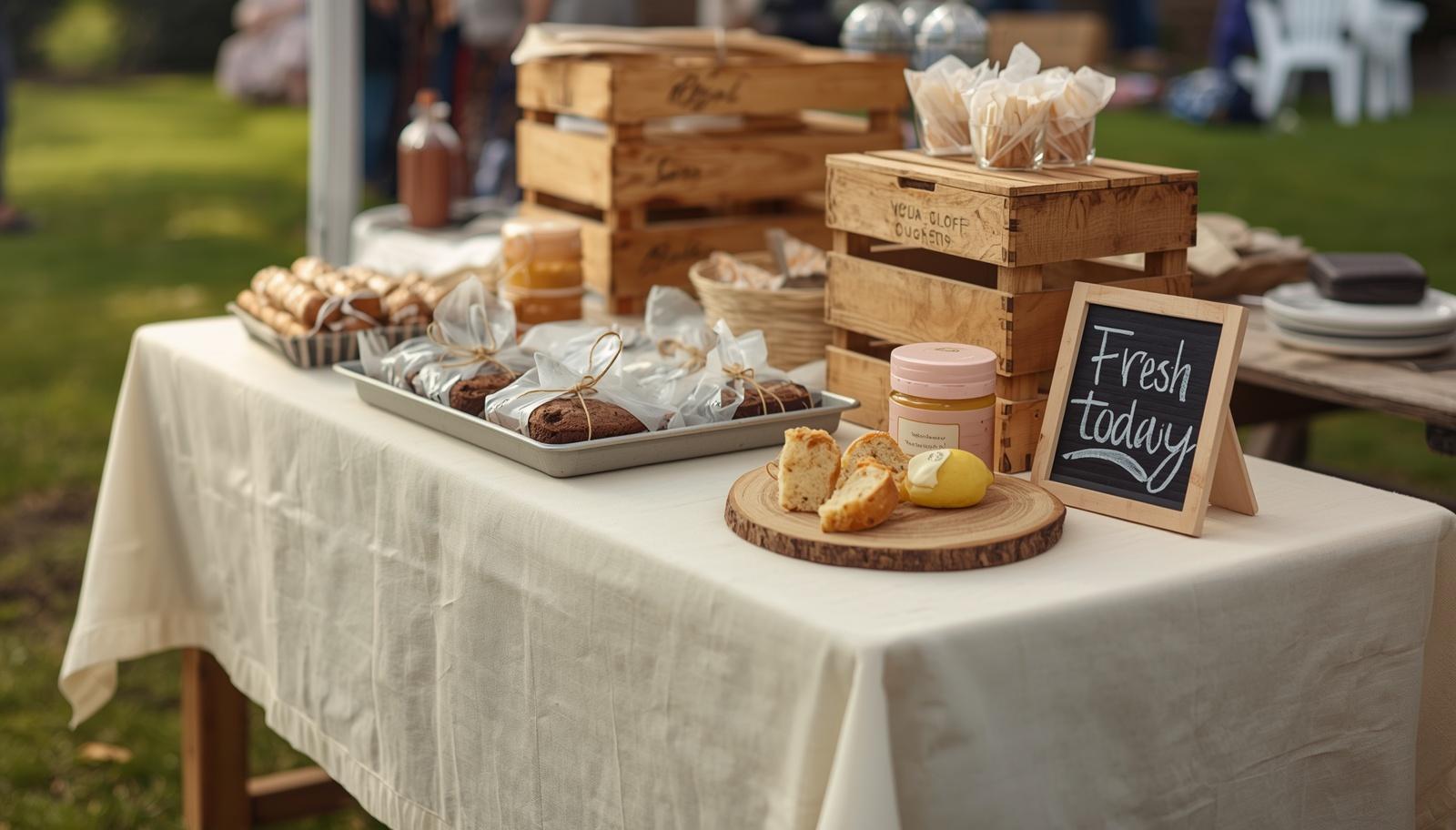
A home baker posted in a UK home-bakery Facebook group last April: “Anyone done a vendor market before? I’ve signed up for my first one and I’ve no clue how much to bring.”
The top reply was from someone who’d been six months earlier: “I did 77 individual cookies and 12, 12-packs. The 12-packs were gone within 2 hours. I will have more of them next time.”
That’s what a first market stall looks like — a real person finding out in real time what she should have brought. The cookies she’d obsessed over the night before hadn’t sold; the 12-packs, which she’d brought as an afterthought, were the day’s hero. She learned more in four hours than she had in six months of social posts. That’s the good news and the bad news.
This guide walks you through the whole day, end to end — how to find the market, what it’ll cost you, how much to bake, what to take on the day, how to run the stall, and what to do with what you learn afterwards. If you already know the date and just want a number to aim at, jump into the Market Day Planner — it takes two minutes.
- First markets fail in one of two ways: bringing too little (sell out at 11am, half the day’s revenue gone) or bringing too much (wastage kills the margin). Planning is the fix.
- UK market stall fees range from £10 (village fete) to £400+ (Christmas markets). The stall fee is the single biggest fixed cost — factor it into your pricing and break-even before you bake.
- Bring a card reader. Cash-only loses you about a third of passing customers. SumUp Solo Lite is the default recommendation for a first market.
- A medium summer fair has 15-40 buyers across the day. Bring around 46 items to cover a busy day with a buffer.
- Bundles (“2 for £6”) outsell singles at markets. Customers buy for gifts and to share.
- Review every market. Write down what sold and what didn’t within 24 hours — your forecasts get sharper in three or four events.
Why most first market stalls go wrong
There are really only two ways a first market stall fails. Almost every baker you’ll talk to has done one or the other.
They bring too little. They sell out at 11am, flattered by the speed, smiling at the empty table. Then they do the maths on the way home and realise they gave away the rest of the day’s revenue. Selling out is a trap dressed up as a compliment.
They bring too much. They want to be safe, they over-bake, they bring three boxes of each product. They end the day with a car boot of unsold brownies, their best-looking cookies are stale, and the wastage eats the margin. They got good reviews and still went home with less money than they spent on ingredients.
Both failures come from the same root — the baker didn’t have a number to aim at. They went by instinct, and instinct is wrong the first time because they’ve never seen the footfall. The fix is simple: plan your volume from expected footfall and conversion before you bake anything. The rest of this guide is what happens around that number.
Finding a market and booking a slot
Most first-time bakers either take the first market that’ll have them, or freeze trying to pick between ten. Both are wrong. Your first market should be small, close to home, and forgiving — not the city farmers’ market you’ve been dreaming of.
Where to look. Council websites list community markets and fêtes. Facebook groups like “UK Food Traders” and “Home Bakers UK” post openings weekly. Local parish councils run village fairs that often skip the formal trader list. Your Instagram followers probably know three markets you don’t — ask them.
What to book first. A village fête or a community market with 200-400 footfall, priced £10-£30. Low risk, low stall fee, forgiving crowd, short day (three to four hours). You’ll learn more at a £20 village fête than at a £100 city farmers’ market where you’re worried about breaking even.
What to ask before you pay the fee. How many traders? (If you’re the only baker, that’s good; if you’re the fifth, think hard.) What’s the expected footfall? (Honest organisers will tell you.) Is there shelter / marquee / electric? (Outdoor markets are cheaper; indoor ones are safer.) What’s the cancellation policy? (If they don’t answer this, walk away.)
Book one. Put the date in your calendar. Work back from there.
How much UK market stalls actually cost
Stall fees are the single biggest fixed cost of your day. Know what’s fair for the tier you’re in and you’ll stop overpaying almost immediately.
| Market tier | Typical daily fee | Best for | |---|---|---| | Village fêtes & community events | £10–£25 (often donation-based) | Your first market — lowest stakes, lowest expectations | | Weekly local markets | £20–£60 | Repeat slots once you’ve done one or two | | Farmers’ & city-centre markets | £50–£120 | Better-paying customers; usually a waiting list | | Christmas & specialist food festivals | £100–£400+ | Only after 5–6 smaller markets under your belt |
A few markets charge per metre of frontage (common at city markets) — typically £30-£80 per metre, with a 2-3 metre minimum pitch. If you’re at a 3-metre pitch at £40/m, that’s £120 for the day, regardless of how many traders.
The practical rule. Your stall fee should be covered by the first 8-12 units you sell. If the maths says you need to sell 30 units just to break even on the pitch, the market is too expensive for what you’re bringing — find a smaller one.
How much to bake
This is the question every first-time market baker asks, and the one that’s hardest to guess right without data. The short version:
Estimate the upper end of the market’s footfall — a busy day, not a typical one. Sizing for the upside means you have stock if the day exceeds expectation. Assume 3-5% of people who walk past actually buy something (5% is a sensible starting default if your stall has decent signage; 3% if signage or placement is weak). Multiply. Add a 10-20% buffer on top of that. That’s your total items across the range.
A medium summer fair has roughly 300-800 footfall across the day (typical 550, busy 800). At 5% conversion that’s 15-40 buyers. Bake for the upper end (40 buyers) plus a 15% buffer = about 46 items total. Split how you like across your range, with a bias toward bundles (they sell faster than singles).
Do the maths for your actual market in two minutes — the free Market Day Planner takes your footfall, product prices, stall fee, and duration and gives you the total to bake, three revenue scenarios, profit after your fee, break-even units, and your effective hourly rate at the stall.
What to take with you on the day
The fastest-moving market stalls do the same things the slow ones don’t. Most of it comes down to what you bring.
A card reader. Non-negotiable. Around a third of UK adults now rarely carry cash, and that figure is higher among under-35s. A cash-only stall will lose you every walk-up who doesn’t have a fiver in their pocket. SumUp Solo Lite (£25 one-off, 1.69% per transaction, no monthly fee) is the default recommendation for a first market — low volume, low fee, no contract. Pair it to your phone via Bluetooth and you’re done. (Full comparison of SumUp, Square, PayPal Reader, and the rest in the card payments guide.)
A float. £20-£30 of mixed notes and change. Five £5 notes, a few £1 and £2 coins. You’ll take most payments by card, but the rest will often need change for a £20 note someone’s pulled out. Running out of change costs you sales.
A pricing sign. Chalkboard or a printed card on the table — clear, visible, priced in round numbers (£3.50 not £3.49, £6 not £5.99 for bundles). Market customers decide in two seconds. If they have to ask, half of them won’t.
Packaging. (Separate section below — this is the part bakers under-estimate.)
A gazebo and weights (outdoor markets only). A cheap 3m × 3m pop-up is £60-£150 and saves your stall in rain or sun. Bring weights for each leg — water bladders or sandbags — or you’ll chase it across the field in a gust.
Samples, if the market allows. A tray of bite-sized offcuts turns hesitant lookers into buyers. Sampling rules vary by market — check with the organiser.
Bags, bin bags, cloths, a small notebook. Bags for customer purchases, bin bags for the end-of-day pack-down, cloths for sticky hands, notebook for writing down what sold and what didn’t before you forget.
Packaging for a market stall
Packaging is where most first-time bakers leak margin without noticing. The fix is to bake the cost in, not absorb it — and to match the packaging tier to where you actually are.
| Packaging option | Per-unit cost | When to use | |---|---|---| | Grease-proof bag + branded sticker | 8–15p | Singles at everyday markets; where speed of service matters more than presentation | | Plain kraft box + branded sticker | 25–40p | Bundles and gift orders — 80% of the branding value for 20% of the cost | | Fully-printed branded box (ribbons, cellophane) | 40–70p | Gift markets, Christmas fairs, once you’re doing 30+ sales a market |
On a £3 brownie, the difference between a grease-proof bag and a printed box is 30–55p of margin per sale. Lean toward bags for singles and reserve boxes for bundles, where the box is part of the gift.
Hot weather. Chocolate melts at 32°C, buttercream at 24°C. If forecast tops 22°C, bring a cool box with ice packs for anything buttercream-based. Nothing tanks a stall faster than a melted display.
Bundle presentation. “2 for £6” is a proven winner at markets. Customers often buy for gifts or to share, and bundles get to look like a deal. Present them in a small kraft box or tied with baker’s twine — it doubles the perceived value for pennies in cost.
Running the stall on the day
You’ll be behind your table for three to six hours. A few small things make a big difference to what you take home.
Stand, don’t sit. Sitting behind a market stall looks passive. Standing signals open-for-business. Bakers who stand sell 30-40% more on average.
Have an opener. “Fancy a brownie? I’ve got Biscoff and sea-salt.” Two seconds of eye contact + a named product stops a passer-by mid-walk. “Would you like to try a sample?” is the other classic. Practise the line before the day — saying it naturally is harder than it sounds.
Upsell at the till. “Would you like a single or one of the 6-packs? They’re £5 off if you take two.” A scripted upsell at the moment of purchase raises average transaction size by 15-25%. Customers often say yes because they’ve already decided to buy — adding a bundle is easier than the initial decision was.
Handle pricing pushback once, briefly, then move on. Someone will say “£3.50 for a brownie?” on the day. Your response: “It’s hand-made that morning with real butter — and it’s worth it. Try the Biscoff one first.” Confident, short, move on. If they walk, they weren’t going to buy at £2.50 either.
Keep your display tidy. Every 20 minutes, re-plate. Gaps where a bundle sold out look worse than a half-empty table. Move stock forward from the back. A busy-looking stall attracts more customers than a thinly-spread one.
Watch the weather and the clock. Last hour of the market is your clearance hour — drop prices on anything you don’t want to carry home. “2 for £5 (usually £8)” signs work brilliantly in the final 45 minutes.
After the market — a quick review
The single highest-return thing you can do for your next market is write down what happened at this one, within 24 hours, while it’s fresh.
Write down: what sold out, what didn’t, what you wish you’d brought more of, what you wish you’d brought less of, what customers asked for that you didn’t have, how many of each product you actually sold, what your total revenue was, and how long the day actually ran.
Do this every market and by your third or fourth event, your forecasts will be within 10-15% of reality. That’s the whole difference between “I think I brought the right amount” and “I know I did.”
The Market Day Planner includes a copy-paste review template that prompts you for exactly these questions. Fill it in once you’re back home, or with a cuppa the next morning — ten minutes well spent while it’s still fresh.
What to do with leftovers — and why a market is more than same-day profit
A market day’s value isn’t fully captured by the till total at the end. The Market Day Planner gives you the financial picture of the day, but the reasons most bakers keep doing markets are bigger than that — and leftovers are part of the answer, not just the problem.
Leftovers are partial cost recovery, not pure waste. Friends and family, an “I’ve got brownies going at half price” Instagram story, the WhatsApp group of mums at the school gates — most leftovers find a home and recover some of what you spent on ingredients and time. Not all of it; fresh items go stale faster, and a half-price box doesn’t claw back full margin. The planner counts unsold stock as money already spent because that’s the safe assumption for a forecast — in reality you’ll usually recover a meaningful slice of it after the event. Donating the rest to a local food bank, community fridge, or your elderly neighbours is a community-building move that gets noticed too.
A market is a marketing event with money on the line. Hundreds of people walk past your stall and dozens stop to look — every one of them is now someone who’s seen your bake. Getting that many people to see you on Meta ads would cost real money. Get your @-handle on the boxes, a QR code on the price card, and an email-signup card on the till. A market that breaks even on the day quietly delivers custom-order enquiries, new Instagram followers, and the regulars who come back next fortnight. None of that lands in the day’s till total, but it lands in the next month’s revenue.
It’s also paid practice. Every market that doesn’t pencil financially still pays you in real lessons — what sold, what didn’t, what people asked for, how the queue moved at peak time. Your sixth market is usually meaningfully better than your first on the same recipes, because you’ve learned the day. The planner’s forecasts tighten too: by your fourth market, the typical-day figure should be within ~15% of what actually lands.
So plan with the planner, take its bottom-line seriously, but don’t judge whether markets are worth doing on a single day’s till total. The full picture is the day’s takings + the leftovers you sell afterwards + the people who saw your bake + the new emails you took at the till + the lessons that sharpen your next market plan.
A market stall is a learning event first, a selling event second
Your first market won’t be your best. The first one where you’re profitable might be your third. The first one where you’re confident will be your fifth. Everyone who stands behind a market table at a UK event this weekend has had a bad first market — or is about to have one.
The plan helps. The card reader helps. The bundle strategy helps. But the biggest lever is iteration — showing up, writing down what happened, and tuning the next one. Your sixth market will quietly make 2-3 times what your first did, and it’s the same bakes in the same boxes. The difference is you’ve been through the day.
When you’re ready to plan the next one, the Market Day Planner gets you a number to aim at in two minutes.
Common questions about UK market stalls
How much does a market stall cost in the UK?
How much should I bake for my first market?
Do I need a business bank account to sell at a market?
Do I need insurance for a market stall?
What food hygiene rating do I need?
Should I take cash, card, or both?
Do I need to charge VAT?
Price every product properly.
Stop guessing what to charge. The Food Costing Toolkit works out every cost that goes into your products — ingredients, labour, overheads, margin, and platform fees — across six connected spreadsheets. Update one ingredient price and every recipe that uses it recalculates automatically.
Get Price It Right — £79One-time purchase · no subscription · PDF guide included