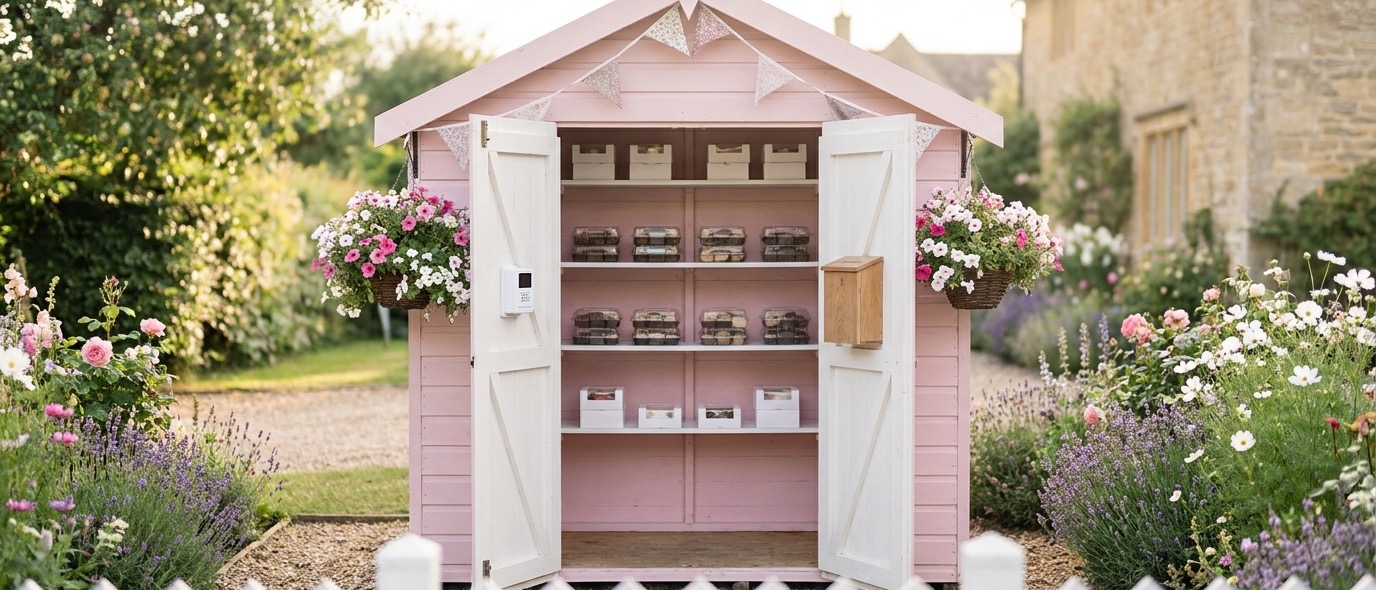
A cake shed is the cheapest commercial baking premises money can buy. No rent. No business rates. No commute. No staff. Most home bakers who set one up are trading inside three months for less than the cost of a holiday.
That’s the good news. The less obvious news is that most of those bakers also under-cost the build, over-estimate the trading, and end up confused about why the maths feels worse on paper than the takings feel in person. This guide is the pre-decision picture: what a UK cake shed actually costs to set up, what you’ll pay every month, what you’ll realistically take through the door, and how long it takes to recoup the spend at honest numbers.
If you’d rather plug your own figures in and see your timeline, the Cake Shed Break-Even Calculator does this in three minutes. Otherwise, read on — the calculator and this guide are built around the same maths and the same vocabulary, so the numbers you’ll see there map cleanly onto the breakdown below.
- Most UK cake sheds cost £550–£1,700 to set up. The shed itself is £130–£300; the rest is fit-out, signage, hygiene cert, and first-year insurance.
- A typical part-time shed (3 days a week, 15 customers, £3.50 average spend) pays back inside two to three months on a £900–£1,000 build.
- The two variables that move your timeline most are days open per week and average spend per customer — and average spend is the bigger lever.
- Card fees and ingredient cost both scale with revenue. Fixed monthly costs are tiny compared to a bakery — usually under £100.
- If your weekly profit is negative, the maths is telling you to fix pricing or footfall before you order the shed, not after.
- A bigger shed isn't the answer to slow trading. Better signage, clearer pricing, and a higher average spend almost always are.
Why a cake shed is different from any other food business
A traditional bakery comes with commercial rent, paid staff, business rates, and full-time hours. A cake shed sits at the front of your house, opens for fixed weekend hours, runs on one person’s labour, and pays no rent. The cost structure is fundamentally different — so the maths needs to be different too.
That difference is what makes a cake shed financially possible at all. A high-street bakery typically needs £25,000–£50,000 of setup capital and £2,000–£4,000 a month of fixed overheads before a single loaf comes out the oven. A cake shed needs maybe £950 to set up and under £150 a month to run — small fractions of either. The trade-off is volume — a shed will never do bakery numbers — but if you don’t need bakery numbers, it doesn’t matter.
The model also gets to lean on assets you already own. The kitchen is yours. The hours are around the rest of your life, not before it. That’s why cake sheds tend to pay back quickly even at modest takings: there’s almost nothing to recoup beyond the build itself, and every £3.50 brownie sold from one is making a real, countable contribution to the spend that got the shed standing.
The downside is the ceiling. A cake shed has a maximum sustainable footfall — once you’ve hit it, the only way to grow is to trade more days or charge more per customer. There’s no equivalent of “open another branch”. For most home bakers, that’s fine — the shed isn’t trying to be the whole business, just a reliable income stream alongside it.
What it actually costs to set up
Six categories of spend take you from “I’m thinking about a shed” to “I’m trading from one”. The cake shed calculator collects exactly these six, and the ranges below match the figures you’ll see in its placeholders.
| Category | Typical UK range |
|---|---|
| Shed (prefab, 6×4 or 7×5) | £130–£300 |
| Decoration & fit-out (DIY) | £100–£350 |
| Power, security & payments (optional) | £0, or £40–£500 |
| Initial stock (opening week) | £50–£200 |
| Food hygiene certificate (Level 2) | £5–£25 |
| Insurance (first year) | £150–£300 |
A few notes the table doesn’t capture:
- The shed itself is usually picked up off Amazon — browse cake shed options here. £180 is a typical mid-range starting point. Bigger sheds rarely earn back their extra cost; the bottleneck on a cake shed is footfall, not floor space.
- Decoration & fit-out is almost always a DIY job — bringing a tradesperson in wipes out the margin you’ve been building.
- Power, security & payments is the most flexible bucket. Most cake sheds get by on battery lights, a small camera, and a SumUp Solo Lite card reader — about £115 all-in. Mains wiring (a socket and light, or running a fridge) adds £200–£400 and is only worth it if you specifically need it. Roughly two-thirds of bakers go without mains.
- Hygiene certificates are free at some councils — they run in-person sessions if you’d rather sit one in person. Check before paying for the online course.
- Insurance is cheapest through specialist home-food-business providers like PolicyBee — they bundle the cover small bakers actually need without padding the premium.
That £945 build is the figure most home bakers actually end up spending. The cheap end of the range (£550) skips the chalkboard, runs on the smallest viable insurance policy, and uses paint left over from the house. The comfortable end (£1,400–£1,700) adds wired power, professional signage printing, a fridge, and a slightly larger opening stock. Pick the build that fits your budget — the calculator works at any of them, and the timeline shifts accordingly.
The monthly costs you'll keep paying
Once the shed is open, four categories of cost recur every month. Two of them are fixed (you pay the same whether you’re busy or quiet) and two of them scale with what you sell. The split matters because variable costs eat into per-sale profit, while fixed costs eat into the timeline directly.
Electricity — £0–£60/month. If you ran a circuit out and you’ve got a fridge or display lights, expect £20–£60 a month depending on usage. If you skipped electrics, this is £0. The calculator defaults to empty for this reason — most cake sheds genuinely don’t have a meter to look at.
Insurance (ongoing) — £15–£25/month. Monthly cost of the same policy you set up in year one, prorated. £18/month is typical for a home-baker shed policy. Some providers bill annually; if so, divide by 12 and treat it as monthly for the maths.
Card-reader transaction fees — 1.5%–2% of revenue. A SumUp Solo Lite costs 1.69% per transaction. Square is 1.75%. PayPal Reader is 1.75%. None of these have a monthly fee — you pay only when you take a payment. The cake shed calculator defaults to 1.69% because SumUp is the most common reader for sheds, but the percentage is editable. Card fees are a variable cost — they scale with revenue, so they don’t change your timeline directly, but they do thin the per-sale margin you’re using to recoup the setup. For the full payments setup — reader vs QR, weatherproofing, signal, and how to absorb the fees in your prices — see How to set up a cake shed for taking payments.
Ingredients — £100–£600/month. The biggest of the four, and the most under-thought. The cake shed calculator asks you to enter your monthly ingredient spend specifically for the shed (not personal baking, not market-stall baking) and converts it into a percentage of your projected revenue. For a typical shed turning £700 a month with ingredient spend around £180, that’s roughly 26% of revenue — about right for cakes and traybakes priced sensibly. If your ingredient ratio is creeping past 35%, the bakes themselves are probably under-priced.
The fifth bucket — packaging, marketing, maintenance — is the one most bakers forget exists. £75 a month covers grease-proof bags, branded stickers, a small contingency fund for repairs and replacements, and the occasional leaflet drop or boosted post. The calculator defaults to £75 in a single “everything else” field, but lets you split it into packaging / maintenance / marketing if you want to track them separately.
Total recurring monthly cost for a typical shed: roughly £100 fixed (insurance + electricity + the everything-else lump) plus 28%-ish variable (card fees + ingredients as a share of revenue). That’s the second number that goes into your weekly profit calculation.
How much you'll realistically take through the door
Three numbers describe what your shed will take in a week: days open, customers per day, and average spend per customer. Multiplying them gives you weekly revenue. The cake shed calculator collects exactly these three.
Days open per week — 1 to 7. Most home-baker sheds run two to four days a week. Friday afternoon and Saturday morning is a classic combination. Seven days a week is rare — even the most committed shed owners tend to take a rest day or two for baking and admin. Start conservative: pick the days you can actually trade reliably for the next six months, not the days you’d open if everything was perfect.
Customers per day — usually 8 to 30. A quiet weekday afternoon in a residential village might pull eight to 12. A busy Saturday morning in a popular dog-walking area can push 30 or more. The number depends entirely on footfall past the shed — which is why location and signage matter much more than shed size. Don’t guess high here. Most bakers significantly over-estimate this number on the first run of the calculator, get a too-good-to-be-true result, and have to revise it down once they’ve actually traded a weekend. Start at 12–15 for a typical residential setup and let real numbers correct it.
Average spend per customer — usually £2.50 to £5.00. This is what customers spend on average across every transaction, not the price of any single item. A shed selling only single brownies at £3.50 has a £3.50 average. Add a “two for £6” multibuy that some customers take, and the average lifts toward £4. Push more customers toward small bundles and the average climbs toward £5. The gap between a £3.50 average and a £5 average doesn’t feel huge per sale, but it’s enormous in aggregate — it’s the lever that pulls break-even forwards by months. This is the most under-thought of the three trading inputs. Bakers will cheerfully spend an evening repainting a chalkboard to attract more footfall, but won’t spend ten minutes thinking about whether the typical transaction could be £4.50 instead of £3.50.
A shed open three days a week, pulling 15 customers per day at £3.50 average spend, is doing £157.50 a week — about £683 a month. Lift the average to £4.50 with a multibuy or a small bundle deal and the same shed is doing £202.50 a week — about £880 a month, with no extra footfall and no extra trading days. Same shed, same customers, almost 30% more revenue, dramatically faster break-even.
How break-even actually works (in plain English)
The maths the calculator runs is one sum, repeated every week of trading.
Weekly revenue is the three trading numbers multiplied together: days × customers × spend. A 3-day, 15-customer, £3.50 shed earns £157.50 a week.
Weekly variable costs are card fees and ingredients combined. A 28% variable rate on £157.50 of revenue is £44 a week. These costs scale with revenue — bigger weeks mean bigger variable costs, which is why a busy shed doesn’t fall over but a quiet shed can.
Weekly fixed costs are everything that doesn’t move with sales: insurance, electricity, and the everything-else lump. A typical £93/month of fixed costs becomes about £21.50 a week.
Weekly profit is weekly revenue minus weekly variable costs minus weekly fixed costs. £157.50 − £44 − £21.50 = £92 a week.
Weeks to break-even is your setup cost divided by your weekly profit. A £945 build at £92 a week pays back in 945 ÷ 92 = 10.3 weeks — about ten weeks from opening day. After that, the £92 a week becomes profit you actually keep.
That’s it. There’s no clever trick, no compounding, no leverage. The maths is deliberately simple because the model is deliberately simple. If you’d rather not do the multiplications, the Cake Shed Break-Even Calculator plugs your real figures in and gives you the answer in three minutes — including a chart of cumulative cost vs cumulative revenue over the first year, and a first-year profit forecast.
Plug your own setup costs, monthly running costs, and weekly trading into the free Cake Shed Break-Even Calculator — it works out your weekly profit, plots your break-even week, and shows your year-one net at your trading level.
What your timeline is telling you
The number of weeks the calculator returns isn’t just a target — it’s a signal about the health of the business model at the figures you’ve entered. There are six bands, and each one tells you something specific.
| Weeks to break-even | What the maths is saying | What to do |
|---|---|---|
| Under 12 weeks | Fast payback. Maths checks out comfortably at this trading level. | Re-run with conservative numbers — you may be assuming a busier-than-typical week. |
| 12 to 26 weeks | Solid. The standard, healthy outcome for a typical home-baker shed. | Bump average spend by 50p with the slider; usually pulls break-even forwards by a month. |
| 26 to 52 weeks | Works, but tight. Pricing or footfall has room to improve. | Fix per-item margin (recipe costing) or revise footfall down before you commit. |
| 52 to 78 weeks | Borderline. Over a year leaves no room for a quiet quarter or a price spike. | Revisit price per customer specifically. If you can’t get under a year, the build is probably premature. |
| 78+ weeks | Not viable at this level — the maths doesn’t add up at the figures you’ve entered. | Cut build cost, raise prices, expand average spend, or pick a busier location if possible. |
| ”Not yet” (negative weekly profit) | Card fees and ingredient costs are eating the entire margin — there’s no positive profit to divide setup by. | Push price up or footfall up before you order the shed, not after. |
The four mistakes that wreck the timeline
After looking at hundreds of cake-shed scenarios, four patterns show up repeatedly. Each one quietly extends break-even by weeks or months, and each one is fixable before the shed gets ordered.
1. Under-counting setup costs. The shed itself is the line item people focus on, but it’s typically less than half of total setup. Forgetting paint, signage, the chalkboard, the food-safe display containers, the security camera, the card reader, and the first-year insurance is what turns a “£300 cake shed” into a £950 build mid-construction. Plan for £900–£1,000 and you’ll usually be on the money. Plan for £300 and you’ll be financing the rest reluctantly halfway through.
2. Over-estimating footfall. “I get loads of dog-walkers past the house” is a common pre-build claim. Actual paying customers per day on a quiet residential street is usually eight to 15, not 30. Until you’ve traded a weekend and counted real numbers, model the calculator at the conservative end. If the shed pencils out at 12 customers a day, anything above that is a bonus. If it only works at 25, the model is fragile.
3. Cash-only trading. Around a third of UK adults rarely carry cash now, and that share is rising. A cash-only shed loses every walk-up who doesn’t have £4 in their pocket, which on a busy day is a third of your potential sales. A SumUp Solo Lite costs £25 once and 1.69% per transaction — the cheapest single change you can make to your conversion rate. (For the full setup walkthrough — reader vs QR, weatherproofing, signage — see How to set up a cake shed for taking payments.)
4. Pricing flat across the menu. Most shed owners set a single per-item price (“brownies are £3.50, cakes are £4”) without working out what each one actually costs to make. The result is that the high-margin items quietly subsidise the low-margin ones, and the shed’s overall margin is thinner than it looks. The fix is recipe costing — knowing the real cost of every product so you can price each one for profit. The Food Costing Toolkit handles this across your whole menu and is the natural next step once the shed itself pencils out.
When a cake shed isn't the right call
Cake sheds are a near-perfect fit for a particular kind of UK home baker. They’re a poor fit for a few others. Honest about both:
Wrong location. A shed only works if foot traffic walks past it. A house at the end of a long drive, behind a hedge, on a road with no pavement — these are not shed locations. If you can’t see realistic walk-by footfall from your front gate, the maths will struggle at any setup cost. Consider a market stall instead — same products, footfall comes to you for the day, no permanent build.
Wrong product mix. A cake shed leans into ready-to-grab traybakes, brownies, slices, cookies, and small whole cakes. High-labour bespoke products (custom-decorated tiered cakes, wedding orders, Bakewell Tarts that take 90 minutes apiece) don’t suit honesty-style trading — the per-item labour eats the margin. Keep bespoke work in the custom-order channel and put quick-turn products on the shed shelves.
Wrong time horizon. If you need cash this month, a cake shed is the wrong tool. The build takes a few weekends, and even a fast payback is six to eight weeks of trading. A market stall pays back in a single afternoon if you sell out. If short-term cash is the priority, do markets first and revisit the shed once the cash is flowing steadily.
The shed is for the home baker who wants a low-overhead, repeatable, semi-passive income stream alongside the rest of their life. If that’s the shape of what you’re building, the maths will almost always work. If it isn’t, no amount of clever setup will make it.
Bottom line
A UK cake shed costs £550–£1,700 to set up, depending on how much of the build you DIY. It costs £80–£150 a month in fixed running costs, plus 25%–35% of revenue in variable costs (card fees + ingredients). At a typical part-time trading level, it pays back inside two to four months and produces meaningful profit beyond that.
Whether a shed pencils out for you specifically depends on your real numbers — your build cost, your monthly overheads, your footfall, your average spend. The Cake Shed Break-Even Calculator takes those numbers and tells you exactly when the shed turns a profit, what your year-one net looks like, and how the timeline shifts when you change a single variable.
Once the shed pencils out, the next question is whether every product you'll sell from it is priced for profit. The Food Costing Toolkit replaces guesswork with a per-product floor price across your whole menu — so the margin you're using to pay back the shed is one you can actually see and defend.
A shed that pays for itself by month three and runs for years afterwards is one of the highest-return small businesses a home baker can start. The maths just needs to be honest before you order the timber.
Common questions about cake shed costs and break-even
How much does a basic cake shed cost to set up in the UK?
What's a realistic break-even timeline for a UK cake shed?
Is it worth running a cake shed if I work full-time?
What's the most common reason a cake shed doesn't pay back?
Should I build a bigger shed if I have the budget?
Do I need security in my cake shed?
Do I need a street trading licence for my cake shed?
Price every product properly.
Stop guessing what to charge. The Food Costing Toolkit works out every cost that goes into your products — ingredients, labour, overheads, margin, and platform fees — across six connected spreadsheets. Update one ingredient price and every recipe that uses it recalculates automatically.
Get Price It Right — £79One-time purchase · no subscription · PDF guide included