Selling on Deliveroo, Just Eat or Uber Eats looks like the obvious way to grow — millions of hungry people, one tap away. For a home baker, it’s rarely that simple. Between the commission, a hygiene-rating gate you might not clear yet, and apps built for on-demand delivery in half an hour, the maths and the fit are often wrong. This guide gives you the honest picture: what they cost, what you need, and the point at which listing actually makes sense.
- Full-service delivery (the app’s couriers) typically costs ~25–35% of the order plus VAT; self-delivery/order-only tiers are cheaper, roughly 14–17% + VAT — but rates are negotiated and change
- VAT is charged on the commission, so a “30%” deal really costs about 36% of the order once VAT lands — and promotions or ad placement push it higher
- Just Eat wants a Food Hygiene Rating of 3+; Deliveroo and Uber Eats set a lower bar (~2) — but a weak or missing rating still shows on your listing and holds orders back
- The apps are built for on-demand delivery in about half an hour; bespoke, next-day cakes fit that model badly, though boxed brownies, cupcakes or cookies fit better
- Selling via an app is distance selling — allergen info is legally required both before the order and on delivery
- For most home bakers, direct ordering with local collection beats the apps until you’re a registered, inspected, 3+-rated operation
The honest answer: for most home bakers, not yet
Let’s not bury it. For a typical home baker — selling cakes and bakes to order, from a home kitchen, at the hobby-to-side-hustle stage — the national delivery apps usually aren’t the right channel. Three things get in the way, and we’ll take each in turn:
- The maths. A quarter to a third of every order, plus VAT, goes to the platform before you’ve paid for a single egg.
- The hygiene gate. The apps set a minimum Food Hygiene Rating — stricter on some platforms than others — and a new home baker often hasn’t been inspected yet, or scores below what the tougher ones want.
- The fit. These apps promise delivery in about half an hour. Bespoke, next-day cakes are a poor match for that — though ready-made items like brownies, cupcakes and cookies, boxed and ready to hand over, fit it better.
None of that means “never.” It means the apps are worth considering once you’ve grown into them — which we cover at the end. First, the numbers.
What Deliveroo, Just Eat and Uber Eats charge
There’s no public rate card. Commission is negotiated per business — by city, product, order volume, and whatever deal you sign — so anyone quoting you a single exact figure is guessing. What the market data does agree on is the broad shape: every platform runs two models, and the price gap between them is large.
- Full-service (the app delivers). The platform’s own couriers pick up and deliver. This is the pricey tier.
- Self-delivery / order-only. You receive the order through the app but deliver it yourself, or offer collection. Much cheaper.
| Platform | Full-service (app delivers) | Self-delivery / order-only | |---|---|---| | Deliveroo | ~25–35% + VAT | Lower self-delivery tier | | Just Eat | ~25–30% + VAT | ~14–17% + VAT | | Uber Eats | ~30% + VAT | ~14–17% + VAT |
Treat these as ballpark ranges “at the time of writing” — they move, and yours will depend on your contract. Uber Eats also runs tiered plans (Lite / Plus / Premium) whose exact UK percentages vary; don’t budget off a headline number you saw quoted for another business.
Two things the headline rate hides:
- VAT on top. The 20% VAT is charged on the commission. A 30% deal is really about 36% of the order once VAT lands — and if you’re not VAT-registered, you can’t reclaim it, so it’s a straight cost.
- Promotions and ads are extra. “Buy one get one,” featured placement and in-app advertising all sit on top of commission and eat further into the margin.
What that does to your margin
Put a real order through it. Say a customer spends £25 on a full-service order at 30% commission:
So roughly £9 of a £25 order — about 36% — is gone before you’ve paid for ingredients, packaging, or your own time. When ingredients and labour already eat most of the price, there’s often little left. That’s the heart of the problem: baked goods carry too much cost to comfortably give away a third of the top line. Faster, ready-made lines like brownies or cookies stand a better chance than bespoke work, but even they feel the squeeze.
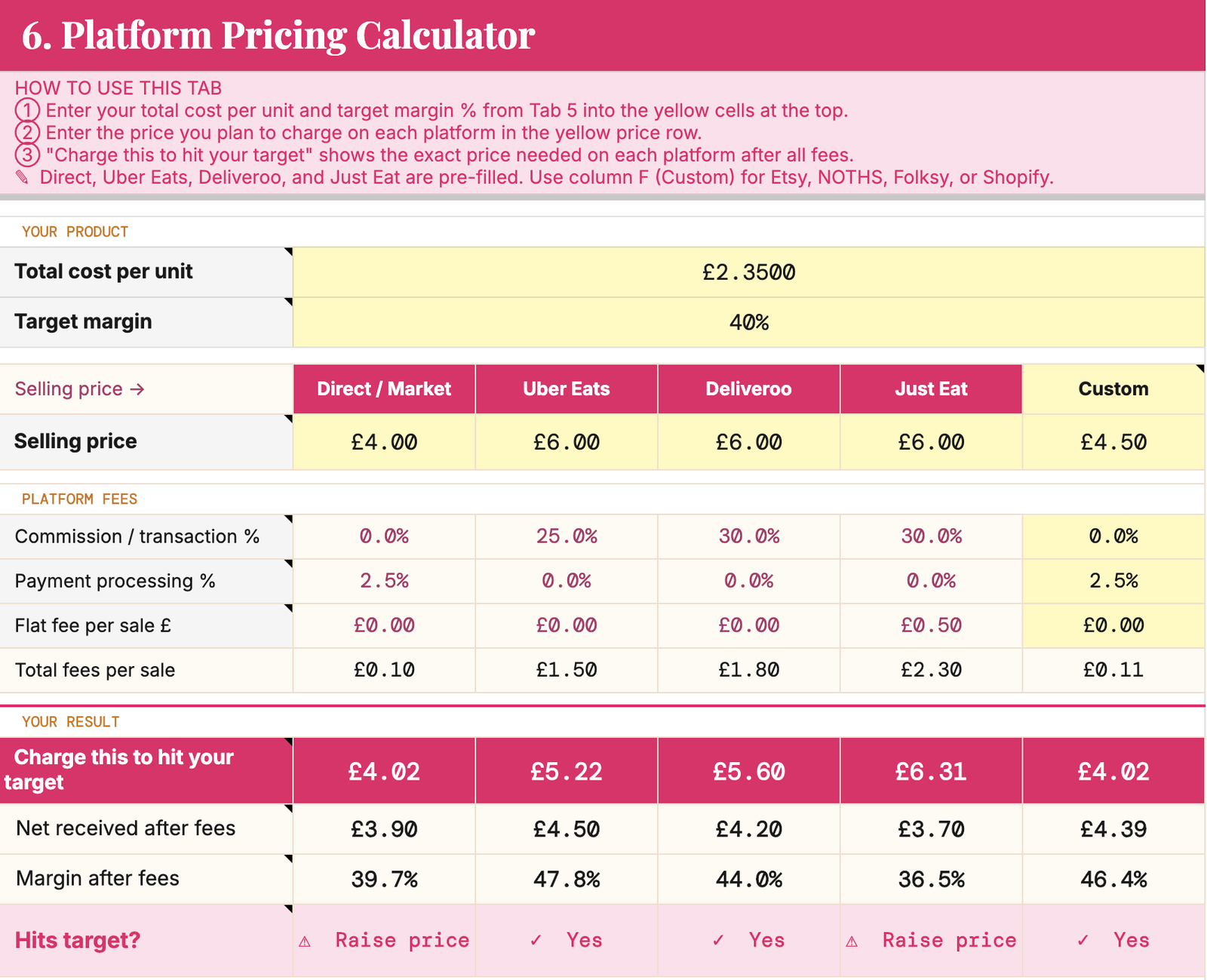
Before you decide whether a channel can carry a 30% cut, you need to know your real cost per order. The Food Costing Toolkit works out your true cost and floor price per product, then lets you model what’s left after platform commission — so you can see, in pounds, whether an app order makes money or loses it.
The hygiene-rating gate
One practical hurdle most guides skip: the apps set a minimum Food Hygiene Rating to list, and it varies by platform. Under a voluntary 2022 industry charter, Just Eat asks for 3 or above, while Deliveroo and Uber Eats set a lower floor of around 2 — and a brand-new home baker may still be “awaiting inspection” until their council visits. It isn’t the law forcing the apps to check; it’s their own policy. It doesn’t affect selling directly to your own customers — but if the apps are your plan, it’s worth knowing where you stand and which platform to approach first.
What you need to list
If you do clear the gate, here’s the checklist every platform will want:
- Food business registration with your local council — free, and required at least 28 days before you trade (this is a legal requirement for any home baker, apps or not).
- A Food Hygiene Rating that clears the platform’s minimum — Just Eat wants 3+, Deliveroo and Uber Eats around 2 — from your council inspection.
- A business bank account for payouts.
- A menu with prices and full allergen information (see the rules below).
- Trading hours you can reliably staff — the apps expect you open and accepting when your listing says so.
- An order device or integration — the supplied tablet, or a POS link.
- A way to fulfil — either your own delivery (self-delivery tier) or the readiness to hand finished orders to a courier on demand (full-service).
You’ll also want insurance in place before you sell to the public through any channel — see our food business insurance guide for what a home baker actually needs.
The rules you must follow
Two legal points matter more on delivery apps than anywhere else.
Allergen information — twice. Selling through an app counts as distance selling, and the law requires allergen information for the 14 major allergens at two stages: in writing before the customer places the order (on your listing/menu), and again in writing when the food is delivered. This is a requirement, not a nicety — get it wrong and both you and the platform are exposed.
Your hygiene rating on display. Displaying your Food Hygiene Rating is voluntary in England but legally required in Wales and Northern Ireland. The apps themselves show your rating on your listing where they have it, and the Food Standards Agency has said it wants to make display mandatory in England in future — including for online ordering — but that’s a stated ambition, not current law. Either way, a strong rating is a selling point; a weak one is very visible.
Should you raise your app prices?
To survive the commission, many businesses set their delivery-app menu prices higher than their direct prices — commonly somewhere in the 10–30% range, depending on how much margin the commission eats. It’s a widespread tactic, and on paper it protects your margin.
Two cautions before you rely on it. First, it’s guidance, not a rule — the right uplift depends on your actual costs, which is exactly the sum the Food Costing Toolkit is built to do. Second, some platforms discourage or penalise pricing that’s much higher than your in-store price, so check your agreement before you mark everything up — a price-parity clause can cost you promotion or placement.
When it actually makes sense
The apps aren’t a trap — they’re just a channel built for a particular kind of business, and most home bakers aren’t it yet. Listing starts to make sense when three things are true at once:
- You’re registered, inspected and rated — ideally a strong rating, since it’s shown to customers.
- You have a fast, repeatable product — traybakes, cookies, brownies boxed and ready, not next-day bespoke cakes — that suits on-demand fulfilment.
- Your margins can genuinely absorb ~30% + VAT — which usually means volume and efficiency closer to a small commercial kitchen than a home hobby.
There’s also a smarter way to think about the commission. If a listing puts your bakes in front of people who’d never have found you otherwise — and some of them come back to order directly next time — then that first app order works a bit like paid advertising. Seen as a customer-acquisition cost rather than a permanent tax on every sale, giving up ~30% once can be worth it, as long as you have a way to turn app customers into direct ones: a flyer or business card in the box, a discount code for ordering direct next time, a follow on social. The goal isn’t to live on the apps — it’s to let them introduce you, then keep the relationship.
Until then, the better growth channel for most home bakers is the one you control: direct orders through your own site or social, with local collection or your own delivery. You keep the full price, you own the customer relationship, and there’s no hygiene gate between you and a sale.
Bottom line
Deliveroo, Just Eat and Uber Eats can work for a food business — but for a typical UK home baker, the commission, the hygiene-rating hurdle, and the on-demand product fit usually make them the wrong first move. Know the real cost of each order before you hand a third of it away, get your registration and rating sorted, and grow the channels you own first. The apps will still be there when your product and your margins are ready for them.
Common questions about selling on delivery apps
Can a home baker sell on Deliveroo, Just Eat or Uber Eats?
How much commission do the food delivery apps take in the UK?
Do I need a food hygiene rating to list on delivery apps?
Do I have to raise my prices on the apps?
What allergen information do I need to give on delivery orders?
Price every product properly.
Stop guessing what to charge. The Food Costing Toolkit works out every cost that goes into your products — ingredients, labour, overheads, margin, and platform fees — across six connected spreadsheets. Update one ingredient price and every recipe that uses it recalculates automatically.
Get Price It Right — £79One-time purchase · no subscription · PDF guide included